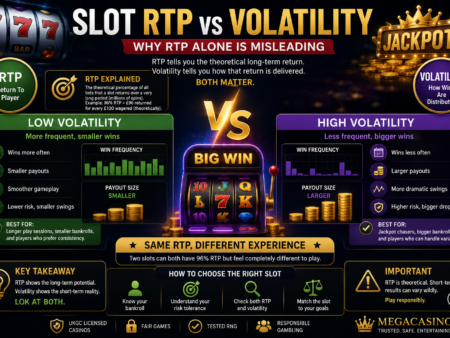
Highest paying online slots are usually identified by their Return to Player percentage, better known as RTP. A slot with a higher theoretical RTP has a lower mathematical house edge than an otherwise comparable game with a lower RTP.
But RTP is frequently misunderstood. A high RTP does not mean frequent wins, predictable payouts or a better result during your next session. This guide explains how high RTP slots work, what the percentages actually mean and which other characteristics UK players should consider when comparing games.
A 97% RTP does not mean that you should expect £97 back from every £100 you personally wager. RTP is calculated across a very large number of game rounds and individual sessions can produce dramatically different results.

New UK casino customers can receive 100 Free Spins after depositing and wagering £10 on qualifying casino games. Spins are worth £0.10 each, must be accepted within 48 hours and used within 7 days. Eligibility and exclusions apply.

Deposit and wager £10 to get 100 Cash Spins worth £0.10 each on Le Bandit. Qualifying winnings are paid as real cash with no maximum cash-out. New UK customers only, 18+. T&Cs apply.

New UK customers can stake £10 or more on QuinnCasino games to receive 50 Free Spins worth £0.10 each on Big Bass Splash. Winnings from the Free Spins are paid as withdrawable cash up to £100. The Free Spins must be used within 7 days.

New UK customers can choose between a £10 Free Bet for sports betting or 100 Cash Spins for casino play. The Free Bet option requires a qualifying £10 bet at minimum odds of 2.0, while the casino option requires a £10 deposit and qualifying wager to unlock 100 Cash Spins worth £0.10 each on Big Bass at the Races. Cash Spins winnings are paid as real cash with no maximum cash-out. Terms and eligibility restrictions apply.
For more guides covering slot mechanics, jackpots and game features, explore the MeganCasino Slots & Jackpots hub.
What Are High RTP Online Slots?
RTP stands for Return to Player. It represents the theoretical percentage of wagered money that a casino game is designed to return to players across a sufficiently large number of game rounds.
For example, a slot operating at 97% theoretical RTP has a corresponding theoretical house edge of approximately 3%.
Approximately 3% theoretical house edge.
Approximately 4% theoretical house edge.
Approximately 6% theoretical house edge.
All else being equal, the higher RTP game has the smaller theoretical mathematical disadvantage. The important phrase, however, is all else being equal. Slots can differ significantly in volatility, hit frequency, bonus mechanics and jackpot structure.
What Counts as a High RTP Slot?
There is no universal percentage at which a slot officially becomes a “high RTP” game. The term is generally used comparatively.
For practical comparison, players may encounter slots across ranges such as:
| Example RTP | Relative Level | Theoretical House Edge |
|---|---|---|
| 98%+ | Very high | Below 2% |
| 96%-98% | Higher range | Approximately 2%-4% |
| 94%-96% | Lower relative range | Approximately 4%-6% |
| Below 94% | Relatively low | Above 6% |
These ranges are useful for comparison rather than formal industry classifications. Individual games and operators can offer substantially different RTP configurations.
Examples of Slots Known for High RTP
Several established slot titles have historically been associated with relatively high theoretical RTP settings. However, the RTP available to a UK player should always be checked directly in the current game’s information screen.
Up to around 99% RTP
A classic-style slot historically known for a very high theoretical RTP under particular game settings.
Around 98.6% RTP
A Thunderkick title historically notable for its relatively high theoretical return.
Around 98% RTP
An established NetEnt slot frequently referenced in discussions of higher RTP games.
High RTP under certain settings
Another classic-style game historically capable of operating at a comparatively high theoretical RTP.
Some games can be supplied in multiple RTP configurations. An RTP percentage quoted historically for a particular slot may therefore differ from the version currently available at an individual casino.
Does Higher RTP Mean More Frequent Wins?
No. This is one of the most important misconceptions surrounding high RTP slots.
RTP describes the theoretical amount returned over the long term. It does not describe how frequently winning combinations occur.
Two slots can both have a 97% RTP while behaving very differently:
Returns may generally be distributed through more frequent smaller payouts, although individual results remain random.
Returns may be concentrated into less frequent but potentially larger payouts, producing greater short-term swings.
This is why RTP should never be analysed in isolation.
RTP vs Volatility – What’s the Difference?
RTP and volatility measure different characteristics of a slot.
| Factor | RTP | Volatility |
|---|---|---|
| Measures | Theoretical long-term return | General payout distribution |
| Expressed as | Percentage | Usually low, medium or high |
| Predicts next result? | No | No |
Our dedicated guide explains why two slots with almost identical RTP percentages can produce completely different playing experiences.
Why RTP Does Not Predict Your Slot Session
A theoretical RTP percentage becomes meaningful only across a very large number of game rounds. Your individual session represents an extremely small sample by comparison.
For example, playing a 97% RTP slot does not mean that:
- you will receive £97 for every £100 wagered;
- the game must return money after a losing streak;
- a win becomes more likely because previous spins lost;
- your session will finish close to the theoretical percentage;
- a higher RTP eliminates the possibility of losing your entire playing budget.
Short-term slot results are dominated by randomness and variance. RTP describes the underlying mathematical model rather than an individual player’s expected session result.
Can the Same Slot Have Different RTP Percentages?
Yes. This is particularly important when comparing online slots.
Some game developers provide operators with several mathematical configurations of the same title. The graphics, name and features may look identical while the theoretical RTP differs.
Open the game’s information, help or paytable section and look for its Return to Player information. Do not assume the percentage is identical to one quoted on another casino or an older review.
This makes checking the actual game information more reliable than choosing a slot solely because it appears on a generic “highest RTP” list.
High RTP vs Progressive Jackpot Slots
Progressive jackpot slots require additional consideration because part of their theoretical return may be connected to an extremely rare jackpot outcome.
A large headline jackpot can therefore make a game attractive while telling you relatively little about its ordinary payout pattern.
The theoretical return is distributed according to the game’s regular mathematical model and bonus features.
Part of the theoretical return may be associated with a rare progressive jackpot outcome.
Neither format is automatically “better”. They represent different game structures.
What Else Should You Check Besides RTP?
RTP is useful, but it should form only one part of a slot comparison.
How payouts tend to be distributed.
How frequently winning combinations may occur statistically.
The maximum potential payout under the game’s rules.
Minimum and maximum permitted wager sizes.
Bonus mechanics, jackpot eligibility and individual game rules can also influence how a slot behaves.
How to Check High RTP Slots at UK Online Casinos
Game catalogues differ between casino operators. Some casinos provide RTP information or game filters directly, while others require players to open individual games to check their mathematical information.
- open the game’s information or help section;
- check the RTP of the exact version available;
- review volatility where disclosed;
- check minimum and maximum stakes;
- understand jackpot and bonus mechanics;
- compare the slot rather than relying only on the casino catalogue description.
Game availability and RTP configurations can change, so current information should always be checked directly.
RTP is only one factor. Our main UK casino ranking also compares game selection, payments, platform usability and player protection features.
High RTP Slots & Responsible Gambling
A higher RTP reduces the theoretical house edge relative to a lower RTP game, but it does not turn slots into a profitable activity.
Every slot still carries financial risk, and a player can lose substantially more than the theoretical house edge during an individual session.
Treat slots as paid entertainment, set an affordable budget and never increase stakes because you believe a high RTP game is more likely to recover previous losses.
Explore More Online Slot Guides
Learn more about RTP, volatility, progressive jackpots, slot tournaments and other features used by online slots.
Frequently Asked Questions
What does RTP mean in online slots?
RTP stands for Return to Player. It represents the theoretical percentage of wagered money a slot is designed to return across a very large number of game rounds.
What is considered a high RTP slot?
There is no official threshold, but slots around or above 96% are commonly compared with lower-RTP alternatives, while games approaching 98% or more are relatively high.
Do high RTP slots pay more often?
Not necessarily. RTP describes theoretical long-term return, while hit frequency and volatility relate more directly to how frequently and in what pattern payouts may occur.
Does 97% RTP mean I get £97 back from £100?
No. A 97% RTP is a theoretical long-term figure calculated across a very large number of game rounds. Your individual result can be much higher or lower.
Can the same online slot have different RTP settings?
Yes. Some slot providers offer multiple mathematical configurations of the same game. Check the information screen of the version you are actually playing.
Is high RTP more important than volatility?
They describe different characteristics. RTP represents theoretical long-term return, while volatility describes the general distribution and size pattern of payouts. Both are useful when understanding a slot.
Can high RTP slots guarantee better results?
No. A higher RTP means a lower theoretical house edge compared with a lower-RTP game, but it cannot predict or guarantee the result of an individual session.