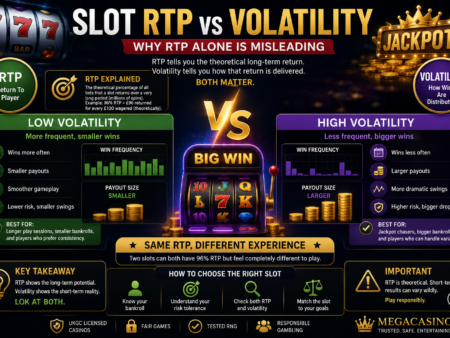
Low and high volatility slots can have similar RTP percentages while producing very different playing experiences. Volatility describes how a slot tends to distribute its payouts, including the balance between more frequent smaller wins and less frequent potentially larger outcomes.
Understanding volatility helps UK players interpret a game’s mathematical structure more accurately. It does not predict whether a particular session will win or lose, but it can indicate how sharply results may fluctuate and how the game has been designed to distribute its theoretical return.
🎰 Volatility Describes Payout Pattern – Not Winning Probability
A high-volatility slot does not become more likely to produce a large win simply because several previous spins lost. Likewise, low volatility does not make a game profitable or guarantee that a player’s balance will remain stable.

New UK casino customers can receive 100 Free Spins after depositing and wagering £10 on qualifying casino games. Spins are worth £0.10 each, must be accepted within 48 hours and used within 7 days. Eligibility and exclusions apply.

Deposit and wager £10 to get 100 Cash Spins worth £0.10 each on Le Bandit. Qualifying winnings are paid as real cash with no maximum cash-out. New UK customers only, 18+. T&Cs apply.

New UK customers can stake £10 or more on QuinnCasino games to receive 50 Free Spins worth £0.10 each on Big Bass Splash. Winnings from the Free Spins are paid as withdrawable cash up to £100. The Free Spins must be used within 7 days.

New UK customers can choose between a £10 Free Bet for sports betting or 100 Cash Spins for casino play. The Free Bet option requires a qualifying £10 bet at minimum odds of 2.0, while the casino option requires a £10 deposit and qualifying wager to unlock 100 Cash Spins worth £0.10 each on Big Bass at the Races. Cash Spins winnings are paid as real cash with no maximum cash-out. Terms and eligibility restrictions apply.
For more educational content covering slot mechanics, jackpots and theoretical returns, visit the MeganCasino Slots & Jackpots hub.
What Is Slot Volatility?
Slot volatility, sometimes discussed alongside variance, describes the general variability and distribution of payouts built into an online slot’s mathematical model.
The concept is usually expressed in broad categories such as low, medium or high volatility rather than as a single standardised percentage.
Generally associated with more frequent smaller payouts and comparatively smoother short-term fluctuations.
Designed around a balance between payout frequency, payout size and short-term variability.
May concentrate more payout potential into less frequent larger outcomes and create sharper bankroll swings.
These descriptions are comparative rather than guarantees. Even a low-volatility slot can produce a long losing sequence, while a high-volatility game can occasionally produce several wins close together.
Low Volatility Slots Explained
Low-volatility slots generally distribute more of their theoretical return through smaller and comparatively frequent winning outcomes.
This can make the balance appear less erratic during some sessions, but it should not be confused with lower financial risk in an absolute sense. Every real-money slot can still produce losses.
Winning combinations may occur comparatively often but can return relatively modest amounts.
Short-term balance movements may be less dramatic than in a highly volatile game.
Many lower-volatility games allocate less of their payout structure to extremely large individual prizes.
✓ What Low Volatility Actually Means
It describes the game’s payout distribution. It does not mean the slot is safer, profitable or guaranteed to produce longer playing sessions.
High Volatility Slots Explained
High-volatility slots generally distribute more of their theoretical payout potential through less frequent but potentially larger outcomes.
As a result, players may experience longer stretches with limited returns and sharper short-term changes in their balance.
Significant winning outcomes may occur less often within an individual session.
Short-term results can fluctuate more substantially in either direction.
Some high-volatility slots allocate part of their mathematical model to rare large multipliers or maximum wins.
⚠️ High Volatility Does Not Mean a Big Win Is Due
Long losing sequences are not evidence that a large payout is approaching. Previous slot outcomes should not be used to justify increasing stakes or extending a gambling session.
Low vs High Volatility Slots – Main Differences
The two slot styles can be compared across several general characteristics.
| Factor | Low Volatility | High Volatility |
|---|---|---|
| Payout frequency | Generally more frequent | Generally less frequent |
| Typical payout size | Usually smaller | Potentially larger |
| Balance fluctuations | Often smoother | Can be sharper |
| Long losing sequences | May be less pronounced | Can be more pronounced |
| Maximum-win potential | Often lower | Often higher |
| RTP | Can be high or low | Can also be high or low |
The important distinction is that volatility does not determine RTP. Games with very different volatility profiles can still have almost identical theoretical RTP percentages.
Volatility vs RTP – Why They Are Not the Same
RTP and volatility describe separate parts of a slot’s mathematical design.
Describes the theoretical long-term percentage of wagered money that the game is designed to return across a very large sample.
Describes how variable the payout distribution can be and how the theoretical return may be spread across different outcomes.
For example, two slots may both have 96% RTP while one produces frequent small payouts and the other concentrates more of its payout potential into rare large wins.
📚 RTP and Volatility Explained Together
Our dedicated guide explains how RTP and volatility interact and why RTP alone does not describe the experience of playing an online slot.
What Is Hit Frequency?
Hit frequency is another concept that can help explain how a slot behaves. It generally describes how frequently the mathematical model produces a winning combination.
Hit frequency should not be confused with profitability. A game can register winning combinations regularly while many of those payouts remain smaller than the amount wagered.
Long-term theoretical return.
General variability of payouts.
How frequently winning combinations may occur statistically.
Looking at all three concepts provides a more complete picture than relying on a single headline statistic.
Maximum Win and Slot Volatility
Maximum-win figures are commonly highlighted in modern slot marketing. High-volatility games in particular can advertise maximum payouts measured in thousands of times the original stake.
However, maximum win describes the largest theoretical payout permitted by the game. It does not tell you how likely that outcome is.
🏆 Maximum Win Is Not Expected Win
A game advertising a 10,000x maximum win does not mean a player has a realistic expectation of reaching that amount during a normal session. The probability of extreme outcomes can be very low.
Can the Same Slot Have Different Volatility or RTP?
Some providers make more than one mathematical configuration of the same slot available to casino operators.
The game may therefore look identical while its theoretical RTP differs between casinos. Volatility descriptions can also vary in how providers communicate them.
🔎 Check the Exact Game Version
Where available, open the game’s information, rules or paytable to check the RTP and other mathematical information for the version actually offered by the casino.
You can also read our guide to high RTP online slots for more information about theoretical returns.
Does Low Volatility Mean Lower Risk?
Not in the sense of eliminating the possibility of losing money.
Lower volatility can indicate a comparatively smoother payout pattern, but every online slot remains a game of chance with a mathematical house advantage.
- a low-volatility slot can still produce losing sessions;
- frequent wins can still be smaller than the amount wagered;
- lower volatility does not remove the house edge;
- theoretical RTP does not guarantee an individual return;
- playing for longer increases the total amount exposed to gambling risk.
The term should therefore be interpreted as a description of payout distribution rather than a measure of financial safety.
Does High Volatility Mean Better Jackpot Potential?
High-volatility slots often feature larger maximum wins, multipliers or bonus outcomes, but volatility alone does not determine whether a game contains a progressive jackpot.
A progressive jackpot uses a separate prize structure that may grow until a qualifying event occurs.
Describes payout variability and may be associated with rare larger outcomes.
Uses a jackpot mechanism with its own eligibility and triggering rules.
For more information on jackpot mechanics, explore our guide to major UK slot jackpots and progressive wins.
How to Check the Volatility of an Online Slot
Not every provider presents volatility information in exactly the same way.
Before playing, check:
- the game’s information or help screen;
- the paytable;
- provider documentation where available;
- the stated RTP;
- maximum-win information;
- hit frequency where disclosed;
- bonus mechanics and jackpot rules;
- minimum and maximum stake.
Do not try to estimate volatility from a short personal playing session. A small sample of spins cannot reliably reveal the mathematical structure of the game.
Which Slot Volatility Is Better?
There is no objectively superior volatility level.
Low and high volatility describe different mathematical structures rather than better and worse versions of the same product.
🎰 Compare the Whole Game
Consider volatility alongside RTP, hit frequency, stake limits, maximum win, bonus mechanics and jackpot structure. No single statistic can predict whether a particular slot session will produce a favourable result.
Slot Volatility & Responsible Gambling
High-volatility games can create long losing sequences, while occasional large wins can make those outcomes particularly memorable. Both effects can influence decision-making.
Do not increase stakes because a slot appears to be “due”, and do not chase previous losses in an attempt to reach a large bonus or maximum-win outcome.
🛡️ Volatility Does Not Change the Need for Limits
Set an affordable budget before playing, avoid chasing losses and remember that neither low nor high volatility removes the financial risk associated with slot games.
Explore More Online Slot Guides
🎰 Slots & Jackpots
Explore more guides covering volatility, RTP, hit frequency, progressive jackpots, new slot releases and other online slot mechanics.
Frequently Asked Questions
What does volatility mean in online slots?
Volatility describes the general variability and distribution of a slot’s payouts. Lower-volatility games tend to produce smaller payouts more frequently, while higher-volatility games may concentrate more payout potential into less frequent larger outcomes.
What is the difference between low and high volatility slots?
Low-volatility slots generally produce comparatively frequent smaller payouts, while high-volatility slots may produce less frequent but potentially larger outcomes and sharper short-term balance fluctuations.
Is low volatility better than high volatility?
No volatility level is automatically better. They describe different payout structures. RTP, stakes, maximum win, hit frequency and other game characteristics should also be considered.
Does low volatility mean I am less likely to lose?
No. Lower volatility can indicate a smoother payout pattern, but it does not remove the house edge or guarantee a winning session.
Do high-volatility slots have higher RTP?
Not necessarily. RTP and volatility measure different characteristics. A high-volatility slot can have a high or low RTP, just as a low-volatility slot can.
Are high-volatility slots more likely to produce big wins?
High-volatility games may allocate more of their payout structure to relatively rare larger outcomes, but this does not mean a large win is likely during an individual session.
Does a losing streak mean a high-volatility slot is due to pay?
No. Previous losing outcomes do not mean that a future spin must produce a win. Volatility describes the game’s general payout structure rather than predicting individual results.
Where can I learn more about RTP and slot volatility?
Visit our RTP vs Volatility guide or explore the Slots & Jackpots hub for additional guides.